Your 6:15pm class walks in after nine hours of laptop, two video calls and a commute. You hand them a printed “daily mobility routine” with fourteen stretches on it, and by Thursday it’s under a coffee cup. The problem isn’t their hips. It’s that you’ve prescribed homework to people who already feel behind.
Mobility for desk workers works when it’s short, attached to something they already do, and built around the joints that sit still all day. Here’s what the research supports, where coaches overreach, and a ten-minute block you can run tonight.
The desk isn’t the enemy, the stillness is
The scale of sitting is hard to overstate. Statistics Netherlands found that workers sat an average of 8.9 hours a day in 2024, up from 8.6 in 2019. ICT professionals sat 7.1 hours during work alone, and frequent home-workers sat about twice as long on workdays as people on site.
The World Health Organization’s physical activity guidance asks adults to limit sedentary time and stresses that any amount of activity is better than none. That framing matters for coaches: we don’t need to fix the desk, we need to interrupt it.
Interruptions do more than you’d expect. In a 2023 Columbia University lab trial, five minutes of walking every 30 minutes across an eight-hour sitting day cut blood sugar spikes by 58% compared with sitting throughout, and every walking schedule lowered blood pressure by 4–5 mmHg. It was a small study of 11 adults, so treat the exact numbers loosely, but the direction is clear: frequent, small movement beats one heroic session.
What mobility work actually changes
Stretching does improve range of motion. A 2024 meta-analysis of 77 studies in the Journal of Sport and Health Science found a moderate effect of stretch training on range of motion, with static and PNF stretching beating dynamic stretching for long-term gains. The surprise was that volume, intensity and frequency didn’t significantly predict results. For busy people, that’s good news: short blocks are not a compromise.
Strength training does too. A 2023 Sports Medicine meta-analysis of 55 trials found that resistance training improved range of motion about as well as stretching, with bigger gains in untrained, sedentary people. One caveat: in that analysis, bodyweight-only training didn’t produce a significant improvement, so add some external load.
For necks and upper backs, strength looks like the better bet. A 2024 review in Applied Ergonomics found that strengthening the neck, shoulder and scapular muscles reduced pain and disability in office workers with chronic neck pain, though the certainty of evidence was low.
- Sitting: 8.9 hours a day for the average Dutch worker in 2024
- Breaks: 5 minutes of walking every 30 minutes cut glucose spikes 58%
- Range: loaded strength work matched stretching for range of motion across 55 trials
What most coaches get wrong
The first mistake is selling mobility as correction. “Your hips are tight from sitting, so do these every night” turns a desk worker’s day into a moral failing. Members hear that they are broken and the routine is the punishment.
The second mistake is length. A twenty-five-minute routine might be ideal on paper, but a ten-minute block done four times a week beats the perfect one done twice in January. The 2024 stretching meta-analysis points the same way: total volume and weekly frequency didn’t significantly predict range-of-motion gains.
The best mobility block is the one that’s already over before they think of skipping it.
The third mistake is treating mobility and strength as separate departments. If loaded movement through a full range improves range of motion, then a slow goblet squat is a mobility drill. Program it like one.
The 10-minute desk-worker block
Run this as the warm-up for any session, or on its own on a rest day. It needs a light kettlebell or dumbbell and a resistance band. Move slowly and keep every rep pain-free.
- 0:00–1:00, march and reach: brisk march or walk in place, reaching both arms overhead every few steps to get the ribcage moving.
- 1:00–2:30, cat-cow to thread the needle: on hands and knees, five slow cat-cows, then five thread-the-needle rotations per side for the upper back.
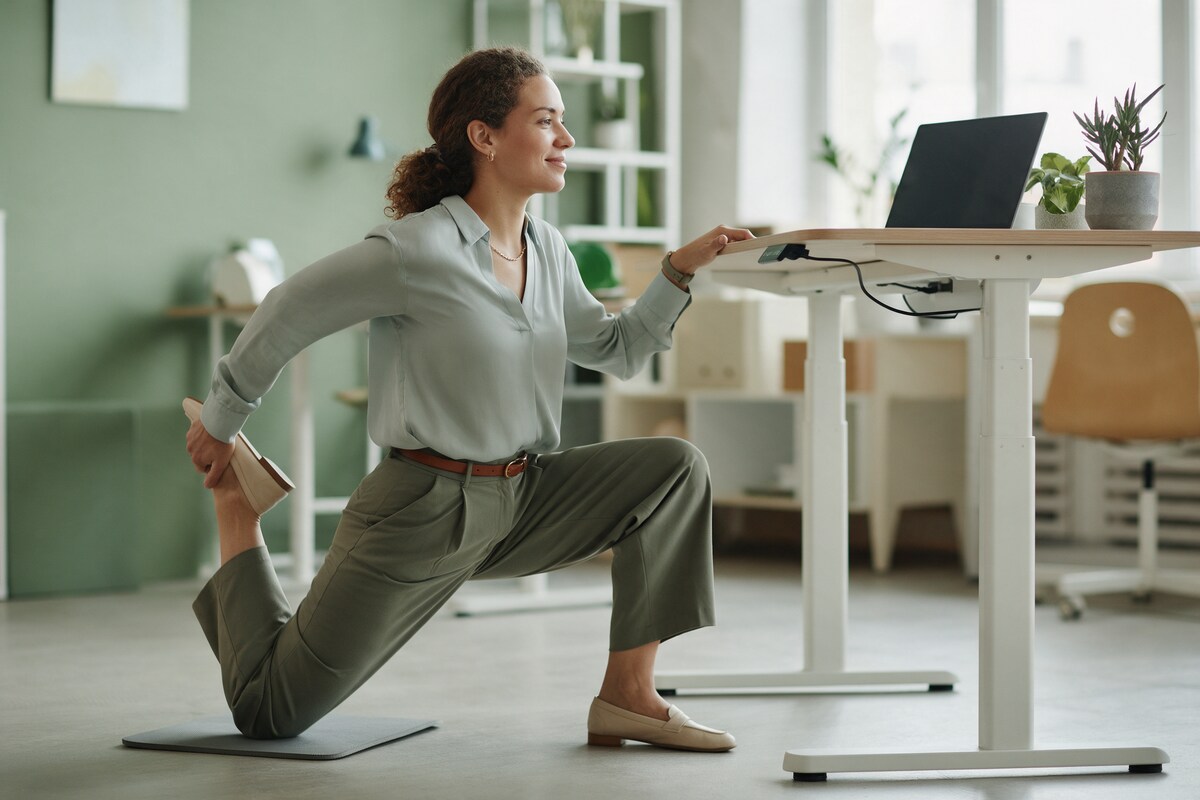
- 2:30–4:00, half-kneeling hip flexor stretch: squeeze the back glute, reach the same-side arm overhead and hold 30–40 seconds per side.
- 4:00–5:30, 90/90 hip switches: sit with both knees bent to 90 degrees and rotate side to side, eight slow switches, using hands for support if needed.
- 5:30–7:00, goblet squat pry: hold a light kettlebell at the chest, sit to the bottom of a squat and rock gently side to side, three holds of 20 seconds.
- 7:00–8:30, band pull-aparts and wall slides: twelve pull-aparts, then eight slow wall slides, keeping the ribs down.
- 8:30–10:00, Romanian deadlift and chin nods: eight slow Romanian deadlifts with a light weight and a three-second lowering, then ten gentle chin nods standing tall.
That’s two hip drills, two upper-back drills and three loaded or strength-based drills, which is the balance the research points to. Swap anything that doesn’t suit a member’s body or space.

The four-minute meeting-break version
Between calls, members can do one minute of brisk walking, one minute of standing thoracic rotations with arms crossed, one minute of hip flexor stretch in a split stance against the desk, and one minute of doorway pec stretch plus chin nods. No floor, no equipment, no change of clothes.
Don’t oversell it. A 2022 PLOS ONE meta-analysis found that micro-breaks of ten minutes or less modestly raised vigor and reduced fatigue, but didn’t improve overall work performance. Pitch it as “you’ll feel less flat at 3pm,” not “you’ll get more done.”
Fitting it into the week
Attach the block to things that already happen. Before every class is the easiest win, because the member is already there and already changed. The meeting-break version works best tied to a cue they can’t miss, like the end of each video call or the stand reminder on their watch.
Demand for this is rising. “Balance, flow and core strength” made the top five of ACSM’s 2026 fitness trends, framed as bridging movement quality with mental well-being. Members want to feel looser and calmer, not just stronger.
In Mahdofit, you can set the block as the opening section of every session in a member’s plan and watch the daily soreness check-in. If soreness scores ease over three weeks, show the member the trend; it’s the most persuasive argument you’ll have for keeping it.
When mobility isn’t the answer
Ten minutes of drills won’t fix everything, and it shouldn’t try. New or worsening pain, pain that wakes someone at night, numbness, tingling or weakness down an arm or leg are reasons to refer to a clinician, not to stretch harder.
Expect individual variation, too. Some members will never touch the floor in a 90/90 and don’t need to. The goal is comfortable, strong range for the life they live, not a yoga photo.
Finally, keep the block in proportion. If someone has two hours a week, ten minutes of mobility is fine. Forty minutes is stealing time from the strength work that, according to the data above, improves range of motion anyway.
The short version
- Interrupt sitting often: a few minutes of walking every half hour beats one long stretch at night.
- Keep blocks to ten minutes and attach them to the start of sessions or the end of meetings.
- Use loaded, full-range strength work as mobility, especially for hips, upper backs and shoulders.
- Frame mobility as feeling better, not fixing what’s broken, and show members their soreness trend.
- Refer out for new, worsening or nerve-like symptoms instead of adding more drills.