Most members don’t miss their protein target because they don’t care. They miss it because the only method anyone gave them was weighing chicken and logging it, and they quit that by week three. A palm, a few anchor meals and one weekly question will get most of them close to target, and keep them there.
Take Marco, 41, two kids, three sessions a week. He downloaded a tracking app after onboarding, logged nine days, then went quiet. His coach assumed he’d stopped caring. When she finally asked, the picture was simple: black coffee and a pastry for breakfast, a sandwich at his desk, and nearly all his protein at dinner. He didn’t need an app. He needed two meals fixed.
Why “just track it” fails most members
Food logging is a skill and a daily tax, and most people stop paying it. In a 2023 JMIR mHealth study of a behavioral weight-loss program, only 21% of participants kept logging their diet on at least half the days of each month during the nine-month maintenance phase. Diet logging was the first habit to fade, ahead of weighing and exercise tracking.
Those were people enrolled in a structured program with professional support. Your 6am member with a commute and a toddler is starting from a harder place. If the plan only works while they log, the plan has an expiry date.
That doesn’t make tracking useless. A week of logging can calibrate someone’s eye. It just shouldn’t be the default way most members hit a protein number.
How much protein is actually enough
The ranges are less mysterious than social media suggests. The International Society of Sports Nutrition position stand on protein and exercise puts most exercising people at 1.4–2.0 g per kg of body weight per day, ideally spread across meals every three to four hours.
Mainstream guidance has moved toward that range too. The 2025–2030 Dietary Guidelines for Americans recommend 1.2–1.6 g/kg daily and say high-protein foods should be prioritized at every meal, a clear step up from the long-standing 0.8 g/kg RDA.
For a 70 kg member, 1.4 g/kg works out to roughly 100 g a day. For members carrying significant body fat, we base the number on a realistic goal weight rather than current weight, which keeps targets achievable without changing the habit you’re building.
The GLP-1 member
More of your members are on GLP-1 medications, and they eat noticeably less. A 2025 joint advisory from four obesity and nutrition societies lists adequate protein and strength training to preserve lean mass among its core priorities. For these members, “protein first on the plate” matters more than any gram count, and targets should be set with their prescriber or dietitian.

The hand is the scale
Precision Nutrition’s hand-portion method estimates one palm of cooked protein at about 22 g for women and 24 g for men, roughly 3 to 4 ounces of cooked meat. Their own comparison found hand portions about 95% as accurate as conventional tracking. That is internal data, so treat it as a strong rule of thumb rather than settled science.
The real advantage is that hands scale with bodies. A larger member has larger palms, so the same instruction lands closer to an individual target than a fixed gram number would. Thickness counts too: a palm means the size and thickness of the palm, not a thin slice laid across it.
Now the math gets easy. That 100 g target is four to five palms a day. Three meals with one or two palms each gets most members there, with a protein-forward snack as a backup.
- Target: four to five palms a day for most women, five to six for most men.
- Per meal: one to two palms at every meal, never zero.
- Check: one weekly question, “How many meals had a palm?”
Anchor meals do the heavy lifting
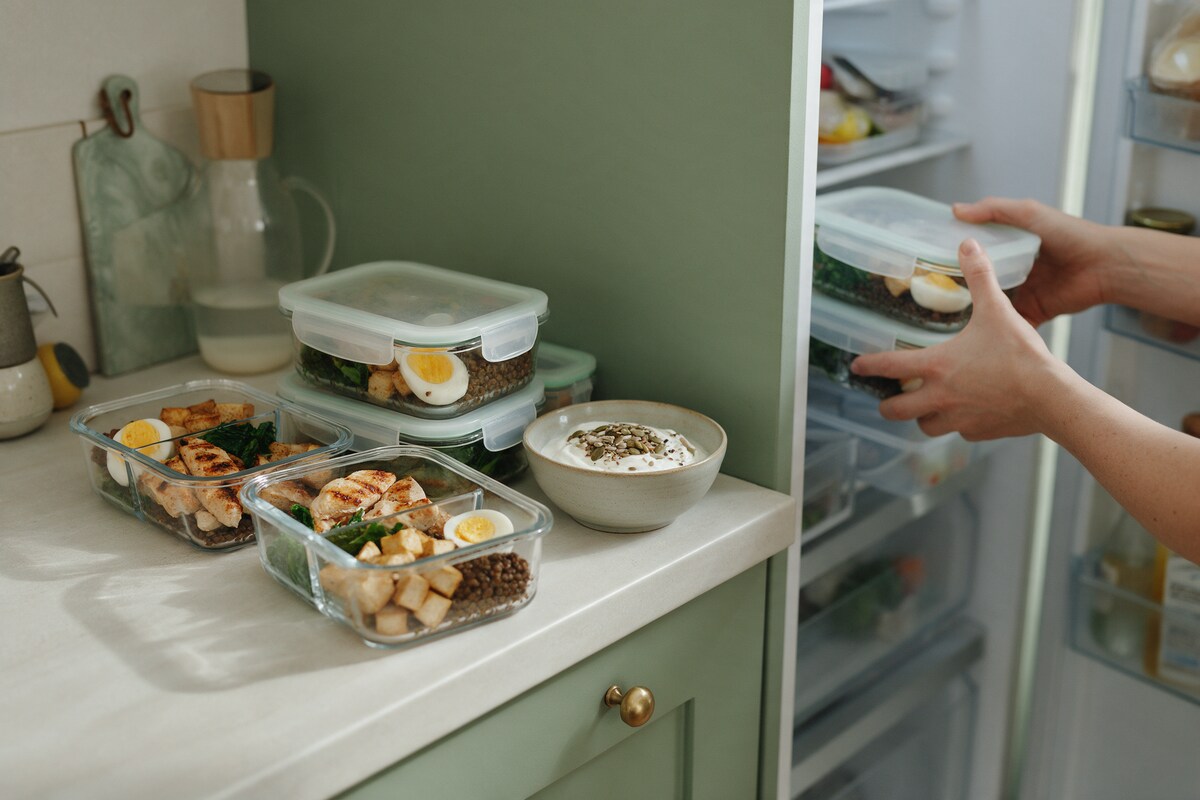
Most people eat the same handful of breakfasts and lunches on repeat. That is a gift. Upgrade those defaults once and the member hits target on autopilot, with no daily decisions to make.
- Breakfast: usually the weakest meal. A bowl of Greek yogurt or cottage cheese is roughly a palm; three eggs is a little under one. Pair either with fruit or toast and it’s done.
- Lunch: find the member’s default order and double the protein in it. One request at the counter covers five lunches a week.
- Dinner: often already fine. Check that the palm is a real palm, then leave it alone.
- Bridge snack: for days that go sideways, keep one ready-to-eat option at work or in the bag, such as a shake, jerky or a yogurt.
Ask members to name their anchors in the first week, then write the plan around those meals rather than an idealized menu. In Mahdofit, the nutrition plan can be written in palms and anchor meals instead of grams, so what the member sees matches how you coach it.
What most coaches get wrong
The first mistake is chasing precision before consistency. A member who hits four palms six days a week is in a far better place than one who logs a perfect 140 g twice and then disappears.
The second is the per-meal ceiling myth: the idea that anything above 25–30 g in one sitting is wasted. In a 2023 Cell Reports Medicine study, 100 g of protein after exercise produced a larger and longer-lasting anabolic response, beyond 12 hours, than 25 g. Spreading protein still helps with appetite and getting to the daily total, but Marco’s big dinner wasn’t wasted. It just wasn’t enough on its own.
The third is leading with bars and shakes. They’re useful bridges, and often the easiest option for members with a small appetite. But they rarely become identity. “I’m someone who has eggs at breakfast” sticks better than a pantry of bars.
A target a member hits five days a week beats a perfect number they abandon by Friday.
Checking in without a food log
You still need a feedback loop; it just doesn’t have to be a spreadsheet. The daily check-in can stay focused on sleep and soreness. Protein gets one weekly question, plus the occasional photo of a typical meal.
Scripts that work: “Don’t count grams. Count palms, and aim for one or two at every meal.” Or, when progress stalls: “What did breakfast look like most days this week? Let’s fix that one meal first.”
For the member who likes data: “Track for one week to calibrate your eye, then switch to palms. If your results stall, we’ll do another week.” That turns tracking into a calibration tool rather than a life sentence.
The short version
- Set the target in grams for yourself, typically 1.4–1.6 g/kg, and in palms for the member.
- Aim for one to two palms of protein at every meal, which covers most members at four to six palms a day.
- Fix two anchor meals, usually breakfast and lunch, before touching anything else.
- Drop the per-meal ceiling myth; the daily total matters most.
- Replace food logs with one weekly palm question, and use a week of tracking only to calibrate.